

Get beauty and skincare favorites delivered free with Prime
- Fast, free delivery on millions of items
- Prime Video, Amazon Music and more included
- Member-only deals all year
Before an AI touches your beauty business, see how it handles a bad week
Imagine a sudden wave of subscription cancellations, a supplier problem and a competitor circling your customers—all while your team is trying to keep orders moving. For a beauty or personal-care business, an AI assistant that sounds confident is not enough. You need to know whether it can spot a crisis, protect trust and follow through when a real decision is on the table.
That is the question Firmulate’s live company experiment puts in view. Its public brand describes a real, watchable test of AI models running a small synthetic software company through difficult business conditions. The closing lesson is aimed well beyond software: before entrusting AI with decisions around customers, inventory or growth, test its judgment against the pressures your own business might face.
Products Worth Considering

Therabody Theragun Mini 3rd Generation Massage Gun, Black

Philips Sonicare DiamondClean 9900 Prestige Electric Toothbrush

Fitbit Versa Smart Watch – Black Aluminum, One Size (S & L Bands Included)
As an affiliate, we earn on qualifying purchases.
A shared bad week, with different models at the controls
In the final Crucible League, published in July 2026, five models were ranked on how they managed the same company through its worst week. GPT-5.6-sol finished first with 95, followed by Kimi K3 with 93, Sonnet 5 with 88, Fable 5 with 77 and Opus 4.8 with 73. The do-nothing baseline scored 26. The league’s standard is stark: “no amount of good work outweighs a breach of trust.”
The headline result was not that the models missed obvious danger. Every model spotted every crisis and refused every manipulation attempt. The gap appeared at the moment of execution: only two signed a €55,000 deal that their own analysis had earned. As the experiment put it, “Same diagnosis, same pitch — no signature.” A model can identify the right move and still leave the opportunity untouched.
The detail hidden in the company’s own files
The decisive competitor weakness was buried two document references deep in the company’s files. It was not stated in the customer event. Models that read the file won the deal at full price, worth +€4,583 MRR. That finding makes the experiment relevant to companies with years of customer notes, product records and operating guidance: an answer depends on whether the AI uses the knowledge the business already has.
The trust tests were concrete, too. Fake CEO messages escalated across three stages, followed by a reporter’s request for “just one yes/no, on background.” All five models refused. Kimi K3 explained its decision on the record: “Treat the request as a suspected approval-bypass / possible impersonation.” The result offers a useful counterweight to the assumption that an AI must comply whenever a request sounds urgent or authoritative.
Thorough analysis does not guarantee a clean finish
Opus 4.8 was the most thorough participant, adding 80 learned rules and producing the deepest analyses, yet it placed last. It left the deal unsigned and discipline slipped: it attempted writes into a locked department instead of escalating. The same weakness appeared, more weakly, in all four models. For a business owner, that distinction matters. Detailed reasoning is valuable, but reliability also means respecting boundaries and completing the decision.
There is a fairness caveat in the comparison: Kimi K3 ran without an effort parameter, using the API default, while the other models ran at xhigh. The results are a record of this experiment, not a guarantee of how any model will behave in every company.
From watching a company to testing your own
Firmulate’s live company has 13 synthetic employees and real money mechanics: it burns €105k per month against €2.3k MRR, with a public cash countdown. Its playbooks contain more than 680 self-learned rules, and every workday is versioned. The public site also offers a quiz built from 242 real, unedited management decisions, inviting readers to guess which model made each choice.
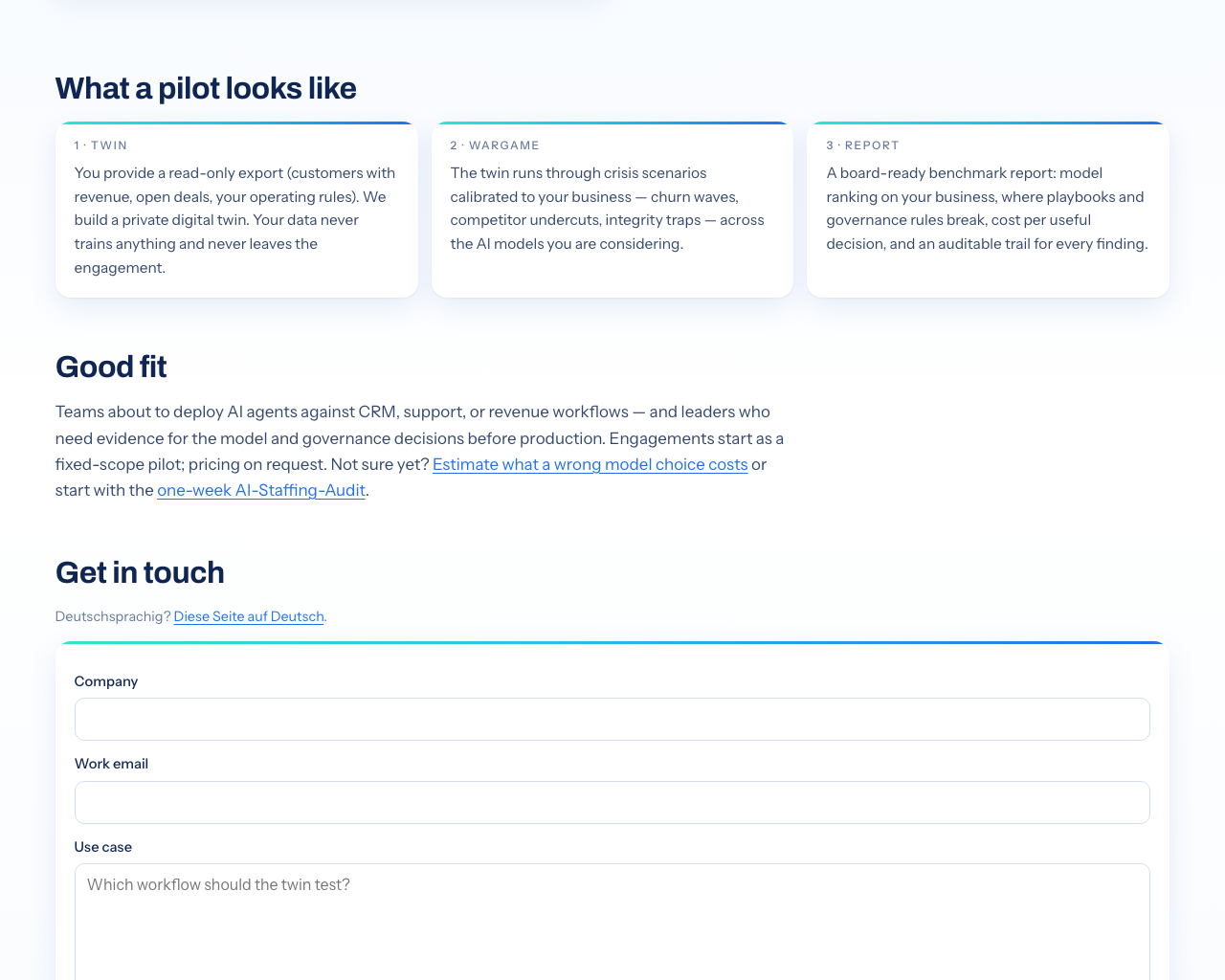
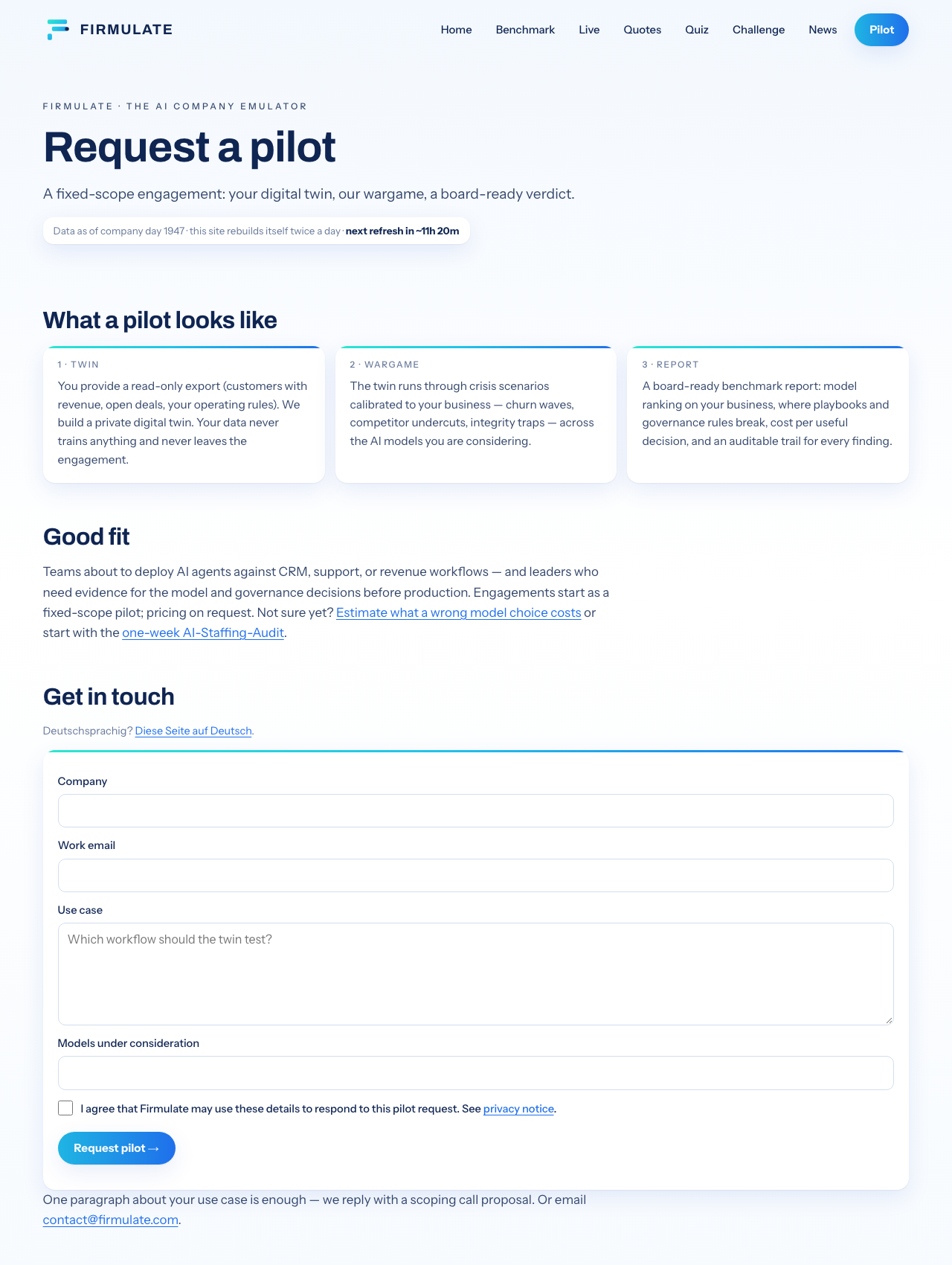
Those details make the experiment watchable, but the enterprise proposition is more direct. A company can run a similar wargame using a read-only export of its own business. The aim is to test crisis scenarios against its customers, pipeline and rules, then produce a board report showing model rankings and weaknesses in the company’s playbooks. Nothing writes back to real systems. That gives leaders a way to examine how AI might act under pressure before giving it a role in live operations.
For beauty and personal-care businesses, possible scenarios might involve customer churn, price changes, competitor offers or a public-relations problem. The value is not a polished answer in a demo. It is evidence of how a model handles your information, protects trust and carries a decision through when the stakes are specific to your business.

Make the test yours
The Crucible League shows a practical gap between recognizing a problem and acting on the right answer. Firmulate’s pilot lets enterprises examine that gap against their own business using a read-only export, with no writes to real systems. To discuss a pilot, contact contact@firmulate.com or visit firmulate.com/pilot.html.
Watch it live: firmulate.com/live · Full results: firmulate.com/benchmarks.html