TL;DR
Placing a noisy computer rig in a closet can quiet your workspace, but only if you manage heat and sound leaks. Proper placement, targeted treatment, and ventilation are key. Foam alone won’t cut it—think barriers, decoupling, and strategic positioning.
Ever wish your noisy AI workstation didn’t drown out your creativity? The secret isn’t just in fancy foam panels—it’s where you place the rig and how you treat the space around it. Moving your setup into a closet or a separate room can make all the difference, turning a loud, distracting machine into a silent partner.
In this guide, you’ll learn why distance beats absorption, how to set up a closet rig that stays cool, and the best ways to block sound leaks without turning your home into a construction zone. Because when it comes to noise, the game is about strategy, not just materials.
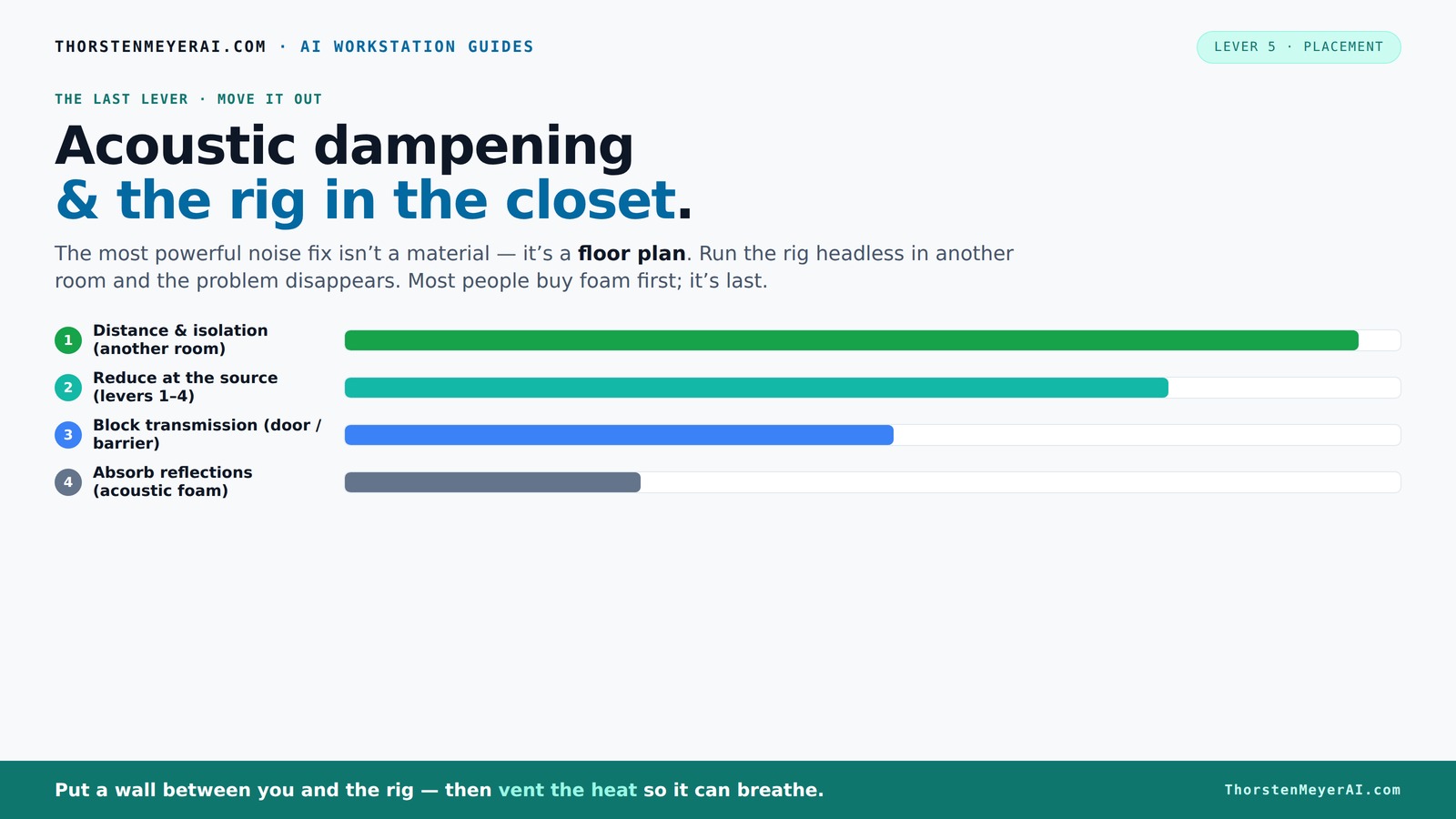
Acoustic dampening
& the rig in the closet.
The most powerful noise fix isn’t a material — it’s a floor plan. A rig you can’t hear because it’s in another room beats any amount of foam. Tap the approaches in Part 1 to see what actually works.
(another room)
(levers 1–4)
(door / barrier)
(acoustic foam)
Contain the noise, not the heat
Key Takeaways
- Moving your rig into a separate room or closet is the most effective way to cut noise without spending a dime.
- Proper ventilation is essential—sealed closets trap heat, which can damage your equipment and increase noise levels. You can learn more about acoustic dampening and setup techniques.
- Placement of acoustic panels at reflection points offers more benefit than covering every wall randomly.
- Foam and blankets help reduce echo but do little to block sound leaks—use them alongside sealing and mass addition.
- For low-frequency issues, thicker panels, bass traps, and decoupling techniques are necessary but not foolproof in small spaces.
soundproof closet for home studio
As an affiliate, we earn on qualifying purchases.
As an affiliate, we earn on qualifying purchases.
Why Moving It Is the Single Best Noise Fix
Putting your rig in another room is the simplest, most effective way to silence it. Think of it like building a wall between you and the noise. When the machine is in a closet, basement, or spare room, the sound waves lose their way before reaching your ears.
Imagine working on your latest AI model, while your GPU hums loudly in a closet across the hall. Your workspace stays quiet, your stress levels drop, and you don’t need to buy a single piece of foam. This approach saves money, effort, and time.
Plus, your connection matters. A wired Ethernet or solid Wi-Fi keeps your setup responsive, while the ventilation ensures the rig doesn’t overheat. This method is especially perfect for remote work, where the physical proximity of the machine isn’t necessary.
acoustic foam panels for noise reduction
As an affiliate, we earn on qualifying purchases.
As an affiliate, we earn on qualifying purchases.
The 'Rig in the Closet' Setup: How to Keep It Cool and Quiet
Sealing a closet with a hot, high-power machine sounds perfect—until it’s not. For more tips on soundproofing, check out soundproofing strategies. Trapped heat turns your quiet setup into a furnace, forcing fans to roar and throttling performance. Overheating can also shorten your hardware's lifespan, risking costly repairs or replacements.
To get this right, ventilation is king. Use a passive vent or, better yet, a quiet exhaust fan that pulls hot air out and draws cooler air in. Proper airflow prevents heat buildup, which is critical for maintaining both quiet operation and hardware longevity. Think of it as creating a mini climate control system tailored for your tech’s needs.
Serious builders often invest in soundproof cabinets with ducted airflow, combining insulation with active cooling. These units balance noise suppression with heat dissipation, keeping your rig cool and quiet for 24/7 operation. Remember: without proper airflow, your rig turns into a hot, noisy mess, risking thermal throttling and hardware failure.
home studio soundproofing barriers
As an affiliate, we earn on qualifying purchases.
As an affiliate, we earn on qualifying purchases.
Soundproofing vs. Acoustic Treatment — What’s the Difference?
Soundproofing and acoustic treatment are often confused, but they serve different purposes. Soundproofing is about blocking noise from escaping or entering a space—think of sealing gaps, adding mass, and decoupling surfaces. This is crucial if you want to prevent your neighbors from hearing your rig or to keep outside noise from interfering with your recordings.
Acoustic treatment, however, improves how sound behaves inside the space. It reduces echo, flutter, and harsh reflections, making your environment more controlled and suitable for accurate recordings or mixing. Proper understanding of these differences helps you prioritize your efforts: sealing gaps for soundproofing and positioning panels for sound quality inside.
In practical terms, if your goal is to silence your setup entirely, focus on barriers and sealing. If you want clearer recordings or a more balanced sound inside your space, invest in absorption and reflection control. Combining both approaches yields the best results, but knowing which to prioritize depends on your specific needs and constraints.
quiet computer rack enclosure
As an affiliate, we earn on qualifying purchases.
As an affiliate, we earn on qualifying purchases.
Where to Place Acoustic Treatment for Maximum Effect
Placement matters more than sheer coverage when it comes to acoustic panels. You might find useful insights in placement and acoustic treatment guides. For your closet rig, the goal is to target the first reflection points—these are the spots where sound bounces directly to your ears or microphone, causing echo and coloration.
Use a simple mirror trick: sit where you record or listen, and have a friend move a mirror along the wall. Wherever you see the reflection of your mic or speakers, place an absorber there. These reflection points are where sound is most likely to cause issues, so treating them reduces echo and improves clarity.
Additional spots include behind the mic, on the ceiling above, and near any hard surfaces that bounce sound directly into your microphone. About 20-40% coverage is enough for a small space; over-treating can deaden the sound or make recordings sound unnatural. Focus on strategic placement rather than covering every inch of wall.
Best Materials for a Closet Rig — What Really Works?
Not all materials are created equal—especially in small, reflective spaces. Learn more about effective materials in materials for acoustic treatment. 2-inch thick foam panels are common for vocals, but for low frequencies and bass buildup, you'll need thicker panels or dedicated bass traps. Thicker panels absorb a broader range of frequencies, reducing muddiness and improving overall clarity.
Rugs and blankets absorb high frequencies and reduce flutter echoes, but they have limited impact on low-frequency sound waves, which tend to bounce around and create bass buildup. Mass-loaded vinyl or additional drywall adds mass to barriers, significantly reducing sound transmission—these are essential for blocking leaks.
Decoupling your equipment from the enclosure with rubber grommets or anti-vibration pads minimizes structure-borne noise, which can otherwise travel through the stand or case. Layering these materials—mass, absorption, and decoupling—creates a more effective noise barrier and acoustic environment.
In a closet, think of layering like building a sandwich: start with mass (drywall or insulation), add absorption (foam or blankets), and finish with decoupling (rubber feet). Each layer addresses a different aspect of sound transmission and reflection, leading to a cleaner, quieter setup.
What Foam and Blankets Can and Can’t Do
Foam panels and moving blankets are popular for quick fixes because they are easy to deploy, but they have limitations rooted in physics. Foam primarily absorbs high-frequency sounds, which helps reduce echo and harshness but does little for low-frequency noise—think of bass sounds that travel through walls and floors.
Moving blankets are versatile—they can be draped, hung, or layered, and they help with reflection and some soundproofing. Thick blankets can reduce sound transmission into or out of a space by several decibels, but only if they are properly sealed around gaps and edges. Without sealing, sound leaks will persist.
Using foam or blankets alone is a common misconception; they are effective as part of a layered approach but are insufficient on their own for full soundproofing. Combining them with sealing, adding mass, and decoupling surfaces yields a much more effective solution. Recognize their limits: they are tools for absorption and minor leakage control, not complete soundproofing.
How Much Coverage Do You Really Need in a Small Space?
For a closet vocal booth, 20-40% coverage with absorption panels usually suffices to tame reflections and improve clarity. Covering every wall isn’t necessary and can deaden the sound, making recordings sound dull and unnatural. Instead, focus on the reflection points and the ceiling, which are critical for controlling how sound interacts with your environment.
Start with a handful of panels—say, four to six—placed strategically at key reflection points. Use smaller panels or a reflection filter at the mic to target problem areas without over-treating. This focused approach ensures maximum benefit with minimal material and avoids creating an overly dead space.
In small rooms, less is often more because excessive treatment can make the space sound unnatural, affecting your recordings and mixes. Prioritize placement over quantity for the best balance of sound absorption and liveliness.
Dealing with Door Gaps and Cracks
Cracks, gaps, and outlets are the biggest leak points for sound. Sealing them is one of the most cost-effective, straightforward ways to improve isolation. These small openings act like tiny speakers, allowing sound to escape or enter, which diminishes the effectiveness of your treatment efforts.
Use weatherstripping around the door frame to create a tight seal, acoustic sealant for cracks, and door sweeps to block the gap at the bottom. For outlets, consider outlet gaskets or plugging holes with foam or putty. These measures prevent sound from slipping through unnoticed, preserving the integrity of your soundproofing efforts.
Think of sealing like patching leaks in a boat—every gap you close enhances your room’s sound isolation. While it may seem minor, these small improvements compound, resulting in significantly less noise leakage and better overall acoustic control.
Low-Frequency Control in a Closet — Is It Possible?
Controlling bass and low-end frequencies in small spaces like closets is particularly challenging because low-frequency waves are long and tend to bounce around, creating standing waves and bass buildup that muddy your sound. These frequencies require more specialized treatment to manage effectively.
Thicker panels, bass traps placed in corners, and room-in-room decoupling techniques help reduce low-frequency issues but are often not enough to fully eliminate them. The inherent size and shape of closets make standing wave patterns difficult to break up, leading to uneven bass response and muddiness.
For serious low-end control, consider adding multiple bass traps in corners and using digital EQ to tame problematic frequencies. Additionally, moving equipment outside the closet or using an external radiator system can help move heat and some low-frequency noise away from your environment, but these are more advanced solutions that depend on your setup and budget.
Reversible, DIY Solutions for Renters
If you're renting, permanent modifications are usually off-limits, but you can still improve your acoustic environment with reversible solutions. Think: moving blankets, portable reflection filters, and temporary door seals—these can be deployed and removed without damaging walls or structures.
Layering blankets or foam over existing walls, using tension-mounted panels, and sealing gaps with removable weatherstripping are effective methods that won't jeopardize your security deposit. These options allow you to experiment with soundproofing and acoustic treatment while maintaining flexibility and respecting your lease agreement.
Such DIY solutions are ideal for testing different setups, making temporary improvements, or adapting your space for specific projects. They also make it easier to revert to the original state when moving out, ensuring you protect your rental agreement while still optimizing your space.
When to Upgrade from Treatment to True Soundproofing
If your primary goal shifts from improving sound quality inside the room to preventing sound from escaping into neighboring spaces or outside, it’s time to consider dedicated soundproofing. This involves adding mass, sealing all gaps, and decoupling surfaces to prevent sound transmission more effectively.
For example, sealing the door gap with a proper seal, adding a layer of mass-loaded vinyl or additional drywall, and decoupling surfaces to prevent vibration transfer can significantly reduce noise leaks—sometimes by over 20 dB. These measures are more involved and costly but are necessary when you need to contain noise rather than just improve internal acoustics.
Recognize that foam and blankets, while helpful for internal sound absorption, are insufficient to block loud noise from escaping. Upgrading to true soundproofing solutions is essential when your setup impacts neighbors or violates noise regulations, ensuring compliance and peace of mind.
Frequently Asked Questions
What is the difference between soundproofing and acoustic dampening?
Soundproofing blocks noise from escaping or entering a space, mainly through sealing gaps and adding mass. Acoustic dampening improves how sound behaves inside a room by reducing echo and reflections—think foam panels and reflection filters. Recognizing this distinction helps you target your efforts effectively: use soundproofing to contain noise, and acoustic dampening to improve sound clarity and reduce harshness within the space.
Where should I place acoustic panels in a closet or small room?
Target the first reflection points—these are spots where sound bounces directly to your ears or mic. Use a mirror trick: sit where you record or listen, and move a mirror along the wall. The points where you see reflections of your speakers or mic are crucial for treatment. Placing panels at these locations reduces echo and improves clarity. Additionally, consider treating the ceiling and behind the mic to minimize sound bouncing from hard surfaces, which can color your recordings.
Do I need bass traps in a closet?
Yes, especially if you notice muddiness or uneven bass response. Bass traps, placed in corners, help absorb low-frequency energy that tends to accumulate there, reducing boominess and improving overall sound balance. While they can’t eliminate all low-frequency issues in small spaces, they significantly improve clarity and prevent bass buildup that can distort your recordings or mixes.
How much wall coverage is enough for a vocal booth in a closet?
Start with about 20-40% coverage, focusing on reflection points and the ceiling. This targeted approach effectively reduces echoes without deadening the space excessively. Over-treating can make the room sound unnatural and dull, so prioritize strategic placement over total coverage. Use smaller panels or a reflection filter at the mic for additional control, and add more treatment only if necessary based on your listening tests.
Are moving blankets effective for soundproofing?
Moving blankets help reduce reflections and can dampen some sound transmission, but they are limited in blocking loud noises. They are most effective when layered and sealed around gaps, but on their own, they won’t fully contain high-volume sound sources. Use them as part of a layered strategy—paired with sealing gaps and adding mass—to achieve better soundproofing results.
Conclusion
The real secret to a quiet, effective home studio isn’t just fancy materials—it’s smart placement and ventilation. When your rig lives in a closet, you turn a noisy problem into a silent partner, as long as you respect heat and sound leak issues.
Remember: the best soundproofing starts with distance, then layers of targeted treatment, and finally, proper airflow. Your workspace—quiet, cool, and ready for action—starts with a plan.