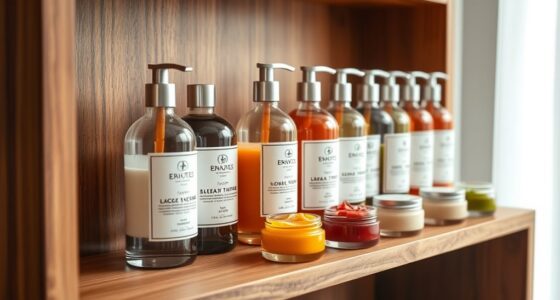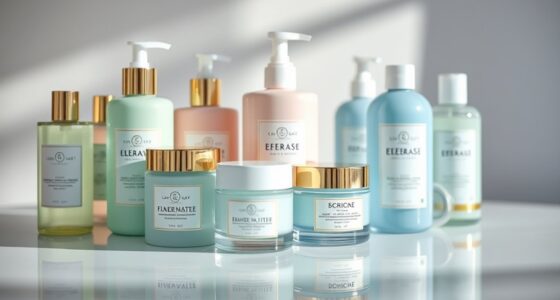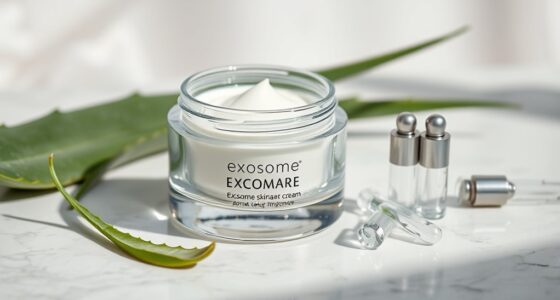
Chemical exfoliants like AHAs, BHAs, and PHAs help improve your skin by removing dead cells and unclogging pores. AHAs are water-soluble and work on the skin’s surface, making them great for brightness and smoothness. BHAs are oil-soluble, penetrate deep pores, and help with oiliness and acne. PHAs are gentle, hydrate, and are suitable for sensitive skin. Understanding these types can help you choose the right one for your skin’s needs and achieve better results.
Key Takeaways
- AHAs are water-soluble acids that target surface dead skin cells, promoting smoother and brighter skin.
- BHAs are oil-soluble acids that penetrate pores to unclog and reduce acne and inflammation.
- PHAs are gentler acids suitable for sensitive skin, providing exfoliation with minimal irritation and added hydration.
- Choosing between AHA, BHA, and PHA depends on skin type, concerns, and sensitivity.
- Proper use and formulation knowledge optimize results and minimize potential irritation from chemical exfoliants.

Have you ever wondered how chemical exfoliants can transform your skin? They’re powerful tools that can reveal a brighter, smoother complexion when used correctly. To understand how they work, it helps to know about the different exfoliant types and whether they’re natural or synthetic. There’s often confusion about this, so let’s clarify: natural exfoliants are derived from plant extracts or fruit enzymes, while synthetic ones are lab-created chemicals designed for specific skin benefits. Chemical exfoliants fall mainly into three categories: AHA, BHA, and PHA, each with unique properties suited to different skin types and concerns.
Alpha Hydroxy Acids (AHAs), like glycolic and lactic acid, are water-soluble and primarily target the skin’s surface. They dissolve the bonds holding dead skin cells together, promoting cell turnover for a radiant glow. Because AHAs are often derived from natural sources like sugar or milk, some consider them more gentle and more compatible with sensitive skin, but they are also manufactured synthetically for consistency and potency. The exfoliant types within AHAs can vary from mild to strong, depending on the concentration used. If you’re dealing with dullness or uneven skin tone, AHAs can be especially effective, revealing fresher skin underneath.
AHAs like glycolic and lactic acid promote cell turnover and reveal brighter, smoother skin.
Beta Hydroxy Acid (BHA), with salicylic acid as the most common example, is oil-soluble, allowing it to penetrate deep into pores. This makes BHA particularly suitable for oily and acne-prone skin. While salicylic acid can be synthetically produced, it’s also derived from natural sources like willow bark. BHA exfoliants help unclog pores and reduce inflammation, making them a go-to choice for those battling blackheads and breakouts. Since BHA works on a deeper level, it tends to be more effective at clearing pores but can be drying if overused, so your skin’s response should guide how often you apply it.
Polyhydroxy Acids (PHAs) are newer and gentler on the skin, especially for sensitive types. They’re often derived from natural sources like milk or fruit sugars, but many are also synthesized to enhance stability and efficacy. PHAs work similarly to AHAs by exfoliating the surface but do so more slowly, reducing the risk of irritation. They also hydrate the skin, making them ideal for those with sensitive or mature skin. The main difference is their gentleness, which allows for frequent use without compromising the skin barrier.
Understanding these differences helps you choose the right chemical exfoliant for your skin’s needs. Whether you opt for natural or synthetic, knowing the exfoliant type and its function ensures you get the best results while minimizing potential irritation. When used properly, chemical exfoliants can considerably improve your skin’s texture, clarity, and overall health.

The Ordinary Glycolic Acid 7% Exfoliating Toner, Brightening and Smoothing Daily Toner for More Even-Looking Skin Tone, 8.1 Fl Oz
EXFOLIATING TONER: Smoothes skin texture, visibly evens tone, and enhances luminosity with daily use.
As an affiliate, we earn on qualifying purchases.
As an affiliate, we earn on qualifying purchases.
Frequently Asked Questions
Can Chemical Exfoliants Be Used With Physical Scrubs?
You shouldn’t use chemical exfoliants with physical scrubs because combining them can cause physical damage and skin irritation. Using both may over-exfoliate your skin, leading to redness, sensitivity, and even broken capillaries. It’s best to choose one method at a time and give your skin time to recover. This approach helps maintain your skin’s barrier and keeps it healthy without the risk of irritation from over-exfoliating.
How Do I Choose the Right Chemical Exfoliant for My Skin?
To choose the right chemical exfoliant, consider your skin type and exfoliant strength. If you have sensitive skin, opt for a gentle PHA or a low-strength AHA. For oily or acne-prone skin, BHA works well. If your skin can handle more, try a stronger AHA. Always start with a lower concentration and gradually increase, paying attention to how your skin reacts to avoid irritation.
Are Chemical Exfoliants Safe During Pregnancy?
Did you know over 50% of pregnant women worry about skincare safety? During pregnancy, chemical exfoliants can be risky if they contain ingredients like retinoids or high-dose BHAs. For pregnancy safety, it’s best to avoid strong acids and consult your healthcare provider. Gentle options like PHA are generally safer, but always double-check ingredient concerns before continuing any chemical exfoliant. Your health and your baby’s safety come first.
How Often Should I Apply Chemical Exfoliants?
You should apply chemical exfoliants 2-3 times a week, following the recommended frequency guidelines. If your skin is sensitive, start with once a week to see how it reacts. Always listen to your skin and adjust accordingly. Over-exfoliating can cause irritation, redness, and dryness, so it’s essential not to overdo it. Consistency and observing your skin’s response will help you find the perfect routine.
What Are the Signs of Over-Exfoliation?
Think of your skin as a delicate garden; over-exfoliation can cause it to wilt. Signs include skin irritation, increased sensitivity, redness, and peeling. You might notice your skin feels tight or looks inflamed after using exfoliants too often. If your skin burns or stings, that’s a clear warning. Keep an eye out—your skin’s reaction is the map guiding you to the right exfoliation balance.

Paula's Choice Skin Perfecting 2% BHA Liquid Salicylic Acid Exfoliant, Gentle Facial Exfoliator for Blackheads, Large Pores, Wrinkles & Fine Lines, Travel Size, 1 Fluid Ounce
GENTLE NON-ABRASIVE LEAVE-ON EXFOLIANT: With 2% BHA (Beta hydroxy acid), to unclog & diminish enlarged pores, exfoliate dead…
As an affiliate, we earn on qualifying purchases.
As an affiliate, we earn on qualifying purchases.
Conclusion
Now that you’re equipped with the knowledge of AHA, BHA, and PHA, think of chemical exfoliants as your skincare’s secret garden. They gently sweep away dead skin like a gentle breeze, revealing fresh, radiant layers beneath. Embrace these powerful allies, and watch your skin bloom with health and vibrancy. With the right choice and care, you’ll open a glowing masterpiece that’s uniquely yours—your skin’s true, luminous canvas.

Meebak Camellia Clear Daily Exfoliating Serum – 2% Niacinamide + AHA & PHA, Gentle Chemical Exfoliant Face Serum for Skin Texture & Tone, Hydrating Pore Minimizer for Face, Korean Skincare
GENTLE DAILY EXFOLIATION — A mild exfoliating serum designed for everyday use to help smooth rough texture and…
As an affiliate, we earn on qualifying purchases.
As an affiliate, we earn on qualifying purchases.
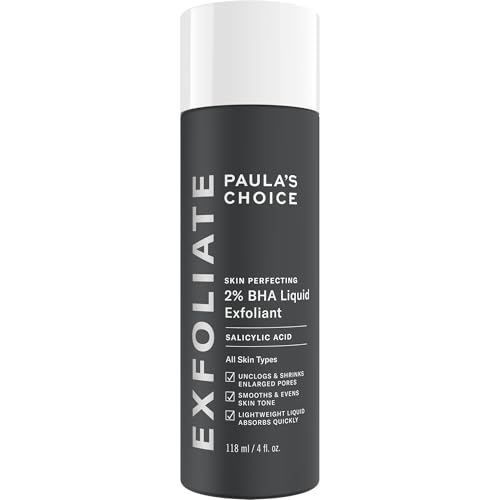
Paulas Choice–SKIN PERFECTING 2% BHA Liquid Salicylic Acid Exfoliant–Facial Exfoliant for Blackheads, Enlarged Pores, Wrinkles & Fine Lines, 4 oz Bottle
GENTLE NON-ABRASIVE LEAVE-ON EXFOLIANT: With 2% BHA (Beta hydroxy acid), to unclog & diminish enlarged pores, exfoliate dead…
As an affiliate, we earn on qualifying purchases.
As an affiliate, we earn on qualifying purchases.